Your Magnetosphere Doesn't Forget: The Surprising Way Past Solar Storms Set Up Future Ones
Imagine you're trying to predict car accidents on a highway. The obvious approach is to watch for reckless drivers — the ones speeding, weaving, creating immediate hazards. That's a reasonable strategy. But what if the real danger wasn't the reckless driver alone, but the reckless driver hitting a stretch of road that was already damaged from last week's accident? Suddenly your prediction model has a problem, because you weren't tracking road conditions. You were only watching the cars.
That's roughly where space weather forecasting finds itself right now.
For most of the history of the field, scientists treated geomagnetic storms as event-driven phenomena. A coronal mass ejection leaves the Sun, travels across interplanetary space, slams into Earth's magnetosphere, and causes a storm. When the solar wind calms down, the magnetosphere recovers, and the slate is wiped clean. Next event, fresh start.
New research is suggesting that last part — the fresh start — is wrong in ways that matter a lot.
What 'Memory' Actually Means in This Context
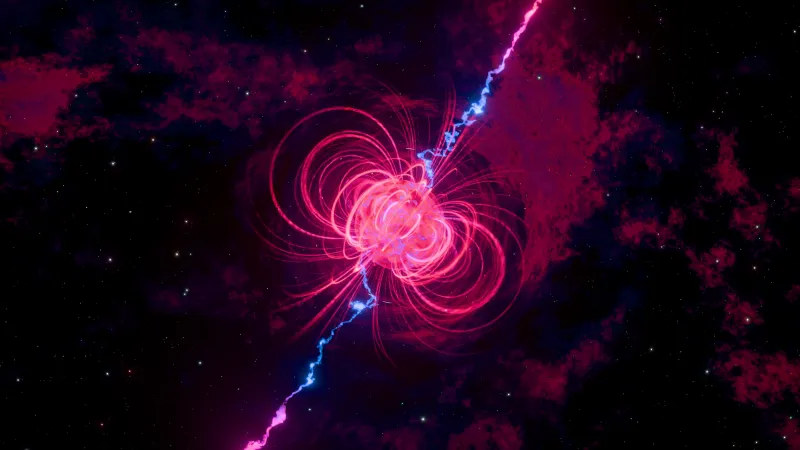
The magnetosphere isn't a rigid shell. It's a dynamic, constantly shifting bubble of magnetic field shaped by the interplay between Earth's own internal field and the continuous pressure of the solar wind. It flexes, compresses, develops internal current systems, and stores energy in ways that aren't always obvious from the outside.
When a strong solar wind disturbance arrives — whether it's a CME, a high-speed stream from a coronal hole, or a particularly dense patch of solar wind — it doesn't just bounce off. It deposits energy into the magnetosphere. Some of that energy goes into the ring current, a donut-shaped band of trapped charged particles circling Earth. Some goes into field-aligned currents that connect the magnetosphere to the ionosphere. Some gets stored in the stretched, tail-like region of the magnetosphere on the night side of Earth.
The classic assumption was that this deposited energy dissipates on timescales of hours to a few days. Storms come, storms go, magnetosphere returns to baseline. Clean.
But researchers studying high-resolution magnetospheric data — particularly from missions like NASA's Van Allen Probes and the European Space Agency's Cluster mission — have been finding something messier. The ring current doesn't always fully drain between events. Particle populations injected during one storm can persist for weeks, subtly altering how the magnetosphere responds to the next incoming disturbance. Electromagnetic structures created during one event can survive long enough to interact with solar wind conditions that arrive later.
The magnetosphere, it turns out, has a memory.
The Evidence Piling Up
Some of the clearest evidence comes from studies of so-called 'double storms' — cases where a moderately strong geomagnetic storm is followed days or weeks later by a second storm that's disproportionately severe given the solar wind conditions that triggered it.
In a fresh magnetosphere, that second event would be unremarkable. But the magnetosphere wasn't fresh. The first storm had pre-loaded the ring current with energetic particles, shifted the structure of the radiation belts, and left the system in a state of elevated sensitivity. When the second solar wind disturbance arrived, it found a magnetosphere that was primed to overreact.
This phenomenon has been documented in statistical analyses of geomagnetic storm records going back decades. Storms that follow closely on the heels of previous activity tend to be more intense than their solar wind drivers alone would predict. That gap between prediction and observation had been chalked up to measurement error or unusual solar wind conditions. Increasingly, researchers think the answer is simpler and stranger: prior storm history matters.
There's also growing evidence from simulations. Global magnetohydrodynamic models of the magnetosphere — the computational workhorses of space weather forecasting — have traditionally been initialized in quiet, idealized states. When researchers instead initialize them with realistic 'pre-conditioned' states reflecting recent storm history, the simulated storm responses change significantly. The same incoming solar wind pulse can produce dramatically different outcomes depending on what the virtual magnetosphere has been through in the preceding days.
Why This Complicates Everything
The implications for operational space weather forecasting are uncomfortable. NOAA's Space Weather Prediction Center, the Air Force, and a growing ecosystem of commercial space weather services all issue geomagnetic storm forecasts based primarily on current solar wind conditions and solar activity. That framework assumes the magnetosphere is, at any given moment, in a predictable baseline state.
If prior storm history meaningfully affects how the magnetosphere responds to new inputs, then forecasts built on that assumption are systematically underestimating risk in certain situations — specifically, periods of elevated solar activity when storms are clustering close together. Which, not coincidentally, is exactly when accurate forecasting matters most.
For satellite operators, power grid managers, and anyone responsible for infrastructure that's vulnerable to geomagnetic disturbances, a model that misses this memory effect isn't just slightly inaccurate. It's inaccurate in the wrong direction, underestimating severity precisely when the stakes are highest.
The Cascading Damage Hypothesis
Perhaps the most provocative idea to emerge from this line of research is what some scientists informally call the 'cascading damage' hypothesis. Rather than catastrophic geomagnetic storms being caused by single, unusually powerful CMEs, some of the most damaging events in recorded history may have resulted from accumulated magnetospheric stress — a series of moderate events that individually wouldn't have been alarming, but collectively primed the system for an extreme response.
The 1989 Quebec blackout, which knocked out power for millions of people for up to nine hours, has traditionally been attributed to a single powerful CME. But the weeks preceding that event were unusually active, with multiple moderate storms. Whether those earlier events contributed to the severity of the March 13th storm through magnetospheric preconditioning is an open research question — but it's no longer a question researchers are dismissing.
The same retrospective analysis is being applied to the Carrington Event of 1859, though the historical data is sparse enough that firm conclusions are elusive.
What Better Forecasting Would Look Like
Addressing the memory effect requires fundamentally changing how space weather models are built and run. Instead of initializing forecast models in idealized quiet states, they'd need to be continuously updated with real-time observations of magnetospheric conditions — ring current intensity, radiation belt populations, tail configuration — and carry that history forward into predictions.
That's technically challenging and computationally expensive. But the alternative is continuing to issue forecasts that treat the magnetosphere as a system without a past, when the evidence increasingly says otherwise.
The solar wind doesn't care about our modeling assumptions. It arrives when it arrives, and it hits whatever magnetosphere happens to be sitting there waiting — scarred, loaded, primed, or calm. Learning to tell the difference between those states before the next storm arrives isn't just an academic exercise. It's the difference between a warning that lands in time and one that doesn't.