When Magnetic Field Lines Snap: The Sun's Hidden Trigger for Its Most Violent Outbursts
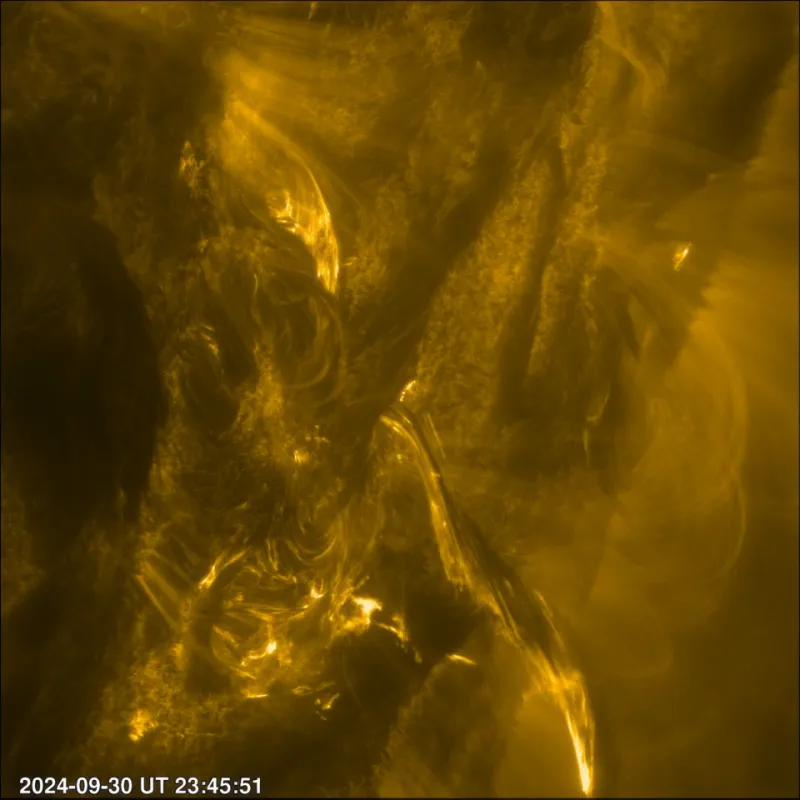
Photo: European Space Agency, CC BY-SA 3.0 igo, via Wikimedia Commons
Imagine stretching a rubber band past its breaking point. For a fraction of a second, nothing happens — and then everything happens at once. That's a rough analogy for what's going on millions of miles above your head right now, in the roiling atmosphere of the Sun. The process is called magnetic reconnection, and it's arguably the most consequential phenomenon in solar physics that most people have never heard of.
When solar physicists talk about what actually ignites a solar flare or launches a coronal mass ejection toward Earth, they keep coming back to reconnection. It's not a side effect of these events — in many cases, it's the cause. And despite decades of study, researchers are still piecing together exactly how to predict when the next snap is coming.
Magnetic Spaghetti Gone Wrong
The Sun doesn't have a tidy magnetic field. Unlike Earth's relatively orderly dipole — two poles, field lines arcing cleanly from south to north — the Sun's magnetic environment is a chaotic mess of loops, tangles, and competing currents. This is partly because the Sun is a plasma, not a solid. Different latitudes rotate at different speeds (a quirk called differential rotation), and that constant shearing motion twists magnetic field lines into increasingly complicated knots over time.
Under normal conditions, plasma in the Sun's corona is essentially locked to those field lines. It can't cross them; it just flows along them. But when two sets of field lines with opposing orientations get pushed close enough together, something breaks down. The neat separation between them collapses at a single point — called the current sheet — and the field lines literally reconnect to new partners. North hooks up with south. The old configuration is gone.
What happens to all that stored magnetic energy? It doesn't politely dissipate. It converts — explosively and almost instantaneously — into kinetic energy, heat, and accelerated particles. We're talking temperatures spiking to tens of millions of degrees in milliseconds. Plasma gets flung outward at speeds that can exceed a million miles per hour. If that plasma is aimed roughly in Earth's direction, we've got a problem.
Why Our Models Keep Getting Surprised
Here's the frustrating part for solar physicists: the basic physics of magnetic reconnection has been understood in outline form since the 1950s. The Sweet-Parker model, followed by Petschek's refinements, laid the theoretical groundwork decades ago. So why does it still feel like the Sun keeps catching us off guard?
The short answer is that reconnection in real solar environments is nothing like the clean laboratory or theoretical version. For one thing, the rate at which reconnection happens in the actual corona is orders of magnitude faster than classical models predict. Something is accelerating the process — turbulence, plasmoid instabilities, or perhaps microscale effects that our instruments can't yet resolve — and nailing down the exact mechanism has proven maddeningly difficult.
There's also the problem of timing. Even when scientists can identify the magnetic conditions that could trigger reconnection, they can't reliably say when the snap will actually occur. The buildup is observable. The trigger is not. It's like watching a pile of dry timber and knowing a fire is possible without knowing if the spark comes in five minutes or five days.
Missions like NASA's Parker Solar Probe and the Solar Orbiter (a collaboration between ESA and NASA) are helping change that. Both spacecraft are getting closer to the Sun than any instruments before them, and they're detecting direct signatures of reconnection events in real time — including those tiny, high-speed plasma jets called switchbacks that Parker keeps recording in the solar wind. Many researchers now believe switchbacks are the downstream fingerprints of reconnection events happening closer to the solar surface.
Reading the Sun's Invisible Mail
One of the more interesting frontiers in this research involves using the Sun's own electromagnetic output as a kind of early warning signal. When reconnection begins ramping up in a region, it produces characteristic radio bursts, specific X-ray signatures, and shifts in the ultraviolet emission from the corona. The challenge is learning to read those signals fast enough to matter.
Research groups at institutions like the Harvard-Smithsonian Center for Astrophysics and NASA's Goddard Space Flight Center are training machine learning models on historical flare data, trying to identify the subtle pre-reconnection signatures that human analysts might miss. Early results are promising, but the models still struggle with the rarest, most powerful events — which, of course, are exactly the ones we most need to predict.
There's also growing interest in a phenomenon called flux rope emergence, where twisted bundles of magnetic field lines rise from beneath the Sun's surface and push into the corona. When a flux rope meets an existing coronal field with the wrong orientation, you've essentially loaded the gun. Whether and when reconnection fires it is the open question.
Why It Matters Right Now
This isn't just abstract physics. We're currently deep in Solar Cycle 25, which has been more active than forecasters initially expected. The Sun has been punching out X-class flares and significant geomagnetic storms with notable frequency. Every one of those events traces back, in some way, to magnetic reconnection.
A powerful enough flare — think the Carrington Event of 1859 or even the more recent Halloween storms of 2003 — can knock out satellite communications, disrupt GPS systems, and in extreme scenarios, damage large-scale power grid infrastructure. The US grid, in particular, has known vulnerabilities to geomagnetically induced currents. FEMA and the Department of Homeland Security have both flagged severe space weather as a legitimate national risk.
So when solar physicists say they're racing to decode reconnection's timing patterns, that urgency is real. Every improvement in lead time — even an extra few hours of warning — gives grid operators, satellite managers, and airline dispatchers (who reroute polar flights during radiation storms) more room to respond.
The Snap Heard Across the Solar System
Magnetic reconnection isn't unique to the Sun. It happens at Earth's magnetopause, in Jupiter's magnetosphere, in distant stellar environments, and probably in the exotic magnetic fields around neutron stars. In a sense, understanding it here — in our own solar backyard, with instruments we can actually send close enough to observe — is a crash course in one of the universe's most fundamental energy-release mechanisms.
But for now, the Sun is the classroom. And the lesson it keeps teaching is that even the most violent events in our solar system start quietly — with two invisible field lines drifting just a little too close together, until something gives.
When it does, we'd really like to know about it before it reaches us.