Losing the Lighthouse Keepers: Why Letting Voyager Go Dark at the Sun's Frontier Is a Mistake We Can't Undo
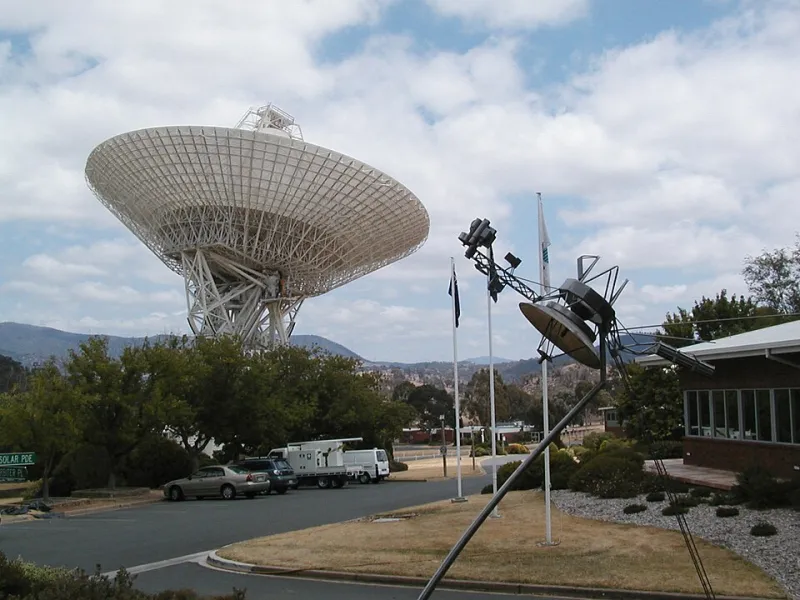
Photo: Wilson Afonso from Melbourne, Australia, CC BY 2.0, via Wikimedia Commons
Let's start with an uncomfortable fact: for nearly fifty years, humanity has had exactly two working weather stations at the edge of the Sun's empire, and both are running out of power.
Voyager 1 and Voyager 2 crossed the heliopause — the boundary where the Sun's wind yields to the interstellar medium — in 2012 and 2018 respectively. Everything we know directly about that boundary comes from them. Not inferred, not modeled. Measured. And right now, mission engineers are shutting down instruments one by one, rationing watts like sailors rationing water, trying to keep a heartbeat going into the 2030s.
What We Lose When the Signal Stops
The heliopause isn't just a line on a diagram. It's the Sun's defensive perimeter — the outer membrane of the bubble our star's magnetic field and solar wind inflate around the entire solar system. Space weather doesn't stop at Neptune. The interaction between solar activity and the interstellar medium happens out there, and we have precisely one pair of sensors in position to watch it happen.
When the Voyagers fall silent, our direct measurements of that frontier end. Full stop. Everything afterward will be modeling — educated guesses layered on data that's decades old and gathered along two specific, narrow paths through an enormous, three-dimensional boundary.
Think about how that sounds in any other context. We wouldn't declare the deep ocean sufficiently understood because two divers swam through it once. But that's effectively the plan.
The Case for a Dedicated Interstellar Probe
A purpose-built interstellar probe — one designed from the start to reach the heliopause quickly and map it, rather than a planetary mission that kept flying — has been on scientists' wish lists for decades. The concepts exist. The launch vehicles exist. What's missing is the national will to prioritize a mission whose payoff arrives decades after the ribbon-cutting.
That's the real obstacle, and it's a political one. A probe to the heliopause doesn't deliver quarterly results. It delivers a torch: a continuous, targeted record of the Sun's frontier for scientists who haven't been born yet. In a budget culture that rewards the next news cycle, slow science gets starved first.
But consider what's at stake. Understanding the heliopause means understanding how our star shields the solar system from galactic cosmic radiation — knowledge directly relevant to astronaut safety, planetary atmospheres, and the habitability of every world we'll ever visit. It means grounding our models of the heliosphere in measurement instead of extrapolation. And it means maintaining continuity: standing on the Voyagers' shoulders instead of climbing back down the mountain.
The Window Is Closing, Not Opening
Here's the kicker: the geometry won't wait. Interstellar probes benefit from specific trajectories and, frankly, we should have launched the successor years ago so the two datasets overlap. Every year of delay widens the gap between the last direct measurement and the next one — a gap that could stretch to half a century or more.
The Voyagers gave us a fifty-year head start on understanding our place in the galaxy. The least we can do is not squander the relay.
Fund the probe. Keep the lighthouse staffed. The frontier deserves a watchman.