Eleven Years of Sun: How Our Star's Mood Swings Quietly Rewire Earth's Weather
Most of us think about weather in terms of what's happening a few thousand feet above our heads — pressure systems rolling in off the Pacific, moisture pumping up from the Gulf of Mexico, a cold front barreling down from Canada. The sun, hovering 93 million miles away, rarely enters the conversation. But it probably should.
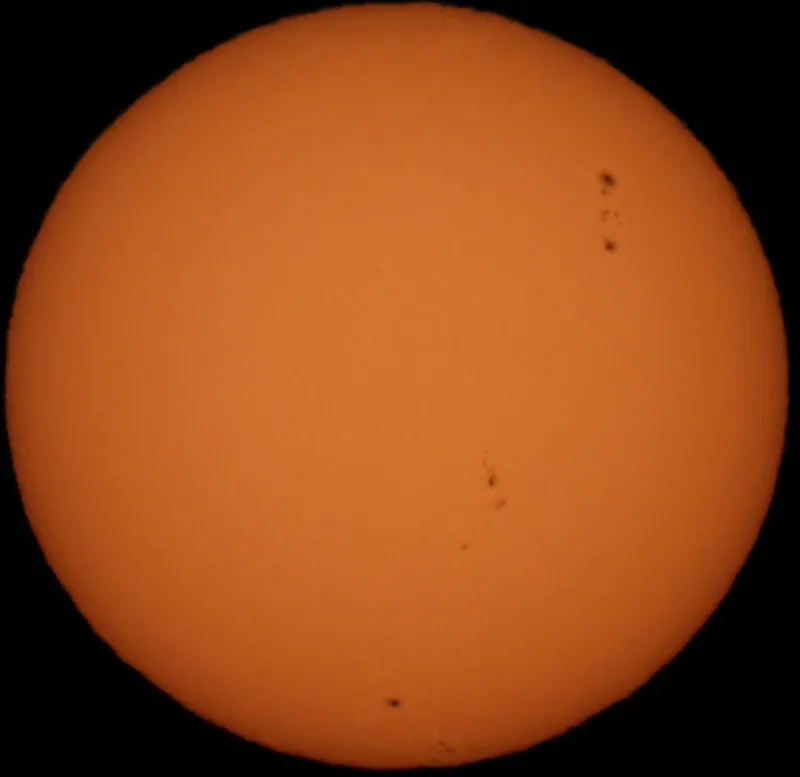
Every eleven years or so, the sun cycles through a period of relative calm and then ramps up to a frenzy of sunspot activity, solar flares, and charged particle outbursts. Scientists call these the solar minimum and solar maximum. And while the total energy output change between these two states is tiny — we're talking about a variation of roughly 0.1% in what's called the Total Solar Irradiance — the downstream effects on Earth's atmosphere appear to be anything but insignificant.
The Sun's Volume Knob Is Subtle, But It's Real
Here's the thing that trips people up: a 0.1% change in solar energy sounds like basically nothing. And in terms of raw watts hitting the top of the atmosphere, it is pretty small. But Earth's climate system is a machine that amplifies small inputs in weird and interesting ways.
One of the better-understood mechanisms involves ultraviolet radiation. During solar maximum, UV output increases by several percent — far more than the overall irradiance change. UV radiation is absorbed primarily in the stratosphere, where it heats up ozone molecules. That stratospheric warming doesn't just stay put. It ripples downward through a process researchers call "top-down coupling," eventually influencing the circulation patterns in the lower atmosphere where all our weather actually happens.
Think of it like adjusting the thermostat in the attic of a house. You wouldn't expect it to do much. But if that attic heat changes the pressure differential between rooms, suddenly the whole airflow pattern shifts.
Jet Streams, Monsoons, and the Arctic Oscillation
Some of the most compelling research in this space focuses on how solar activity interacts with the jet stream — that fast-moving river of air at high altitudes that essentially steers weather systems across North America. Studies have suggested that during solar maximum, the jet stream may shift slightly, altering storm tracks and changing precipitation patterns in ways that can be detected statistically, even if they're hard to see in any single season.
Researchers at institutions like NOAA and NASA's Goddard Space Flight Center have spent years looking at correlations between solar cycle phase and things like drought frequency in the American Southwest, winter severity in the Northern Plains, and even the strength of the Indian monsoon. The results are rarely clean — climate is noisy, and teasing out a solar signal from all the other variables is genuinely hard science. But the correlations keep showing up, cycle after cycle, which is hard to ignore.
The Arctic Oscillation is another area of active interest. This climate pattern — essentially a pressure seesaw between the Arctic and the mid-latitudes — has a documented relationship with solar activity. During low solar activity periods, some research suggests the AO tends toward a negative phase, which means weaker polar vortex conditions. If you lived through any of the "polar vortex" winters in the 2010s, you already have a visceral sense of what that means: brutally cold air spilling down into the continental US when it has no business being there.
The Cosmic Ray Wildcard
There's another mechanism in this story that doesn't get nearly enough attention: galactic cosmic rays. When solar activity is high, the sun's magnetic field expands outward and deflects more of these high-energy particles away from the inner solar system. When the sun quiets down, more cosmic rays penetrate to Earth's lower atmosphere.
A controversial but persistent hypothesis — originally proposed by Danish physicist Henrik Svensmark — suggests that cosmic rays may seed low-level cloud formation by ionizing air molecules and helping aerosol particles nucleate into cloud droplets. More low clouds mean more sunlight reflected back to space, which means a cooler surface. The debate over this mechanism has been fierce in the climate science community, and the evidence remains genuinely mixed. But it's the kind of idea that refuses to die because the physics isn't obviously wrong, and some experimental results have been suggestive.
CERN's CLOUD experiment has been probing this question for years, and while they've confirmed that cosmic ray ionization can influence aerosol nucleation under certain conditions, scaling that up to meaningful global cloud cover changes is still a stretch. It's one of those areas where the jury is very much still out.
Can This Help Us Forecast Better?
Here's where things get practically interesting. If solar cycle phase genuinely influences large-scale atmospheric circulation patterns, that's information forecasters could theoretically use. Long-range seasonal forecasting — the kind that tries to tell farmers and emergency managers whether next winter will be colder or drier than average — is notoriously difficult. Any additional predictive signal is worth chasing.
Some European meteorological services have experimented with incorporating solar cycle data into extended-range models, and early results have been cautiously promising for certain regions and seasons. In the US, NOAA's Climate Prediction Center hasn't formally integrated solar cycle signals into its seasonal outlooks yet, but researchers affiliated with the agency have published work suggesting there's detectable skill to be gained.
The challenge is that solar influences don't operate in isolation. El Niño and La Niña years can swamp solar signals entirely. Volcanic eruptions throw a wrench in everything. And the internal variability of the climate system is enormous. Extracting a consistent, reliable solar fingerprint from all that noise requires long datasets and careful statistics.
We're Still Learning the Language
What makes this whole field so fascinating — and so fitting for what we do here at Infopunks of Sol — is that we're genuinely still decoding the sun's influence on the planet we live on. This isn't settled textbook science. It's active, sometimes contentious research where new datasets from missions like the Solar Dynamics Observatory keep reshaping the picture.
The sun isn't just a passive light source. It's a dynamic, cycling system that has been quietly shaping Earth's atmospheric rhythms for billions of years. Understanding that relationship better isn't just intellectually satisfying — it could eventually make a real difference in how we prepare for the seasons ahead.