Sunspots Are Weirder Than You Think — And Scientists Are Still Losing Sleep Over Them
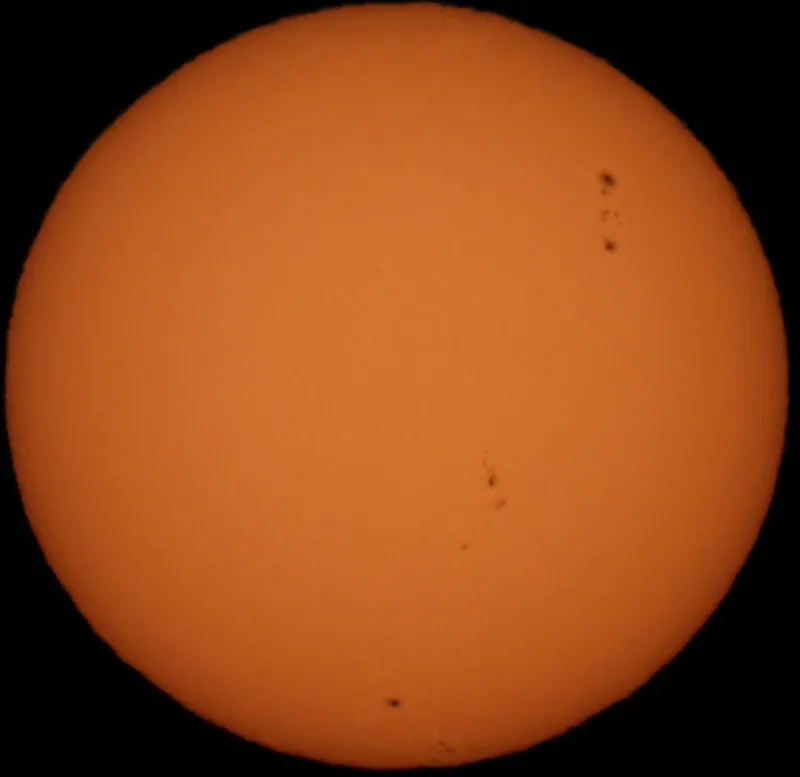
Let's start with something that sounds completely backwards: sunspots are dark because they're cool. On a star with a surface temperature hovering around 10,000 degrees Fahrenheit, sunspots clock in at roughly 6,000 to 7,500 degrees. That temperature difference is enough to make them appear as dark blotches against the blazing photosphere surrounding them.
Now, here's the part that should make you do a double take. Those "cool" sunspots — the ones that look like quiet, dim patches — are actually the source of some of the most violent energy releases in the solar system. Flares. Coronal mass ejections. Geomagnetic storms that can scramble GPS signals, disrupt airline communications, and in extreme cases, take down power infrastructure across entire regions of the country. The same structures that look like the sun is taking a nap are essentially loaded guns.
How does that work? Honestly, we're still figuring it out.
What Even Is a Sunspot?
At the most basic level, a sunspot is a region where intense magnetic field lines have punched through the sun's surface and suppressed the normal convective flow of hot plasma. On the undisturbed sun, energy moves from the interior to the surface via convection — giant churning cells of plasma rising, cooling, and sinking, like a pot of oatmeal on the stove. Where a strong magnetic field interrupts that process, less hot material reaches the surface, and you get a cooler, darker spot.
That much is agreed upon. But zoom in on the details and the agreement starts to fray.
For one thing, the exact mechanism by which strong magnetic field concentrations form and organize into sunspots in the first place is still not fully understood. The leading models involve magnetic flux tubes rising through the convection zone due to buoyancy, eventually breaking through the photosphere in pairs of opposite magnetic polarity. But the dynamics of this process — why some flux tubes make it to the surface and form stable spots while others dissipate — involves magnetohydrodynamics at scales and conditions we can't replicate in a lab and can only partially simulate computationally.
The Umbra, the Penumbra, and a Whole Lot of Fine Structure
Look at a high-resolution image of a sunspot and you'll see it's not just a uniform dark circle. There's a central region called the umbra — the darkest, coolest part — surrounded by a striated outer ring called the penumbra, which has a surprisingly complex structure of light and dark filaments radiating outward like a brushed metal texture.
Those penumbral filaments are their own scientific puzzle. They represent regions where the magnetic field is more inclined relative to the surface, allowing some convection to sneak back in. The interplay between the magnetic field geometry and the convective flows in the penumbra produces patterns that are genuinely beautiful and genuinely not fully explained.
Missions like the Daniel K. Inouye Solar Telescope in Hawaii — currently the most powerful solar telescope on Earth — are giving researchers their best-ever look at this fine structure. The telescope can resolve features as small as 18 miles across on the sun's surface, which sounds enormous until you remember the sun is 865,000 miles in diameter. At that resolution, scientists are watching the penumbra's dynamics in real time and finding that the behavior is even more complex than previous models predicted.
The Trigger Problem
Here's the question that keeps space weather forecasters up at night: why do some sunspots produce massive solar flares and coronal mass ejections while others just sit there doing nothing for weeks before quietly fading away?
Sunspot groups are classified by their magnetic complexity — simple bipolar configurations versus tangled, multipolar arrangements where field lines from opposite polarities are twisted and pressed together. The more complex the magnetic topology, the more energy stored in the field, and the higher the probability of a violent release. That much is understood conceptually.
But the specific trigger — the precise moment and mechanism by which stored magnetic energy suddenly releases as a flare or CME — remains elusive. Scientists can watch a sunspot group grow increasingly complex and say with confidence that the probability of a major event is elevated. What they cannot do is say "the flare will happen in the next six hours" with the kind of reliability that would let satellite operators, power grid managers, and airline dispatchers take meaningful protective action.
This isn't a matter of not trying. Enormous research effort has gone into flare prediction, including machine learning approaches that train on decades of solar observations. Progress has been made. But the fundamental physics of the trigger mechanism — likely involving a process called magnetic reconnection, where field lines of opposite polarity snap and reconnect, releasing stored energy explosively — still has gaps that observations haven't fully closed.
Cycles Within Cycles
Sunspot activity follows the familiar 11-year solar cycle, ramping up to solar maximum and back down to minimum. But within that overarching rhythm, there are patterns and anomalies that don't fit neatly into simple models.
The Maunder Minimum — a period from roughly 1645 to 1715 when sunspots nearly disappeared entirely — is one of the more haunting examples. For about 70 years, the sun essentially stopped producing significant sunspot activity. This period overlapped with the coldest phase of the Little Ice Age in Europe and North America, when the Thames froze regularly and crop failures were common. The causal relationship between the Maunder Minimum and that cold period is debated, but the correlation is striking.
Could something like that happen again? Possibly. Some researchers have suggested that the current solar cycle and the next one show signs of a weakening trend. Others think those predictions are overconfident given how poorly we understand the sun's internal dynamo. It's another open question in a field that has more open questions than most people realize.
Why This Matters Beyond the Science
For all the academic fascination with sunspot physics, there's a very practical edge to this research. We live in a civilization that is profoundly dependent on technology that space weather can damage or destroy. The 1989 geomagnetic storm — triggered by sunspot activity during solar maximum — knocked out power across Quebec for nine hours and caused transformer damage as far south as New Jersey. A repeat of the 1859 Carrington Event, the most powerful geomagnetic storm in recorded history, could cause trillions of dollars in damage to modern infrastructure.
Better understanding sunspots means better understanding the source of space weather. It means longer warning times, more accurate forecasts, and a better chance of protecting the systems we depend on.
Sunspots have been staring back at us since Galileo pointed his telescope at the sky in 1610. Four centuries later, they're still keeping solar scientists honest. That's not a failure of science — it's a testament to just how genuinely complex our nearest star turns out to be.