Ninety-Three Million Miles in Under Two Hours: The Wild Physics of Solar Particle Storms
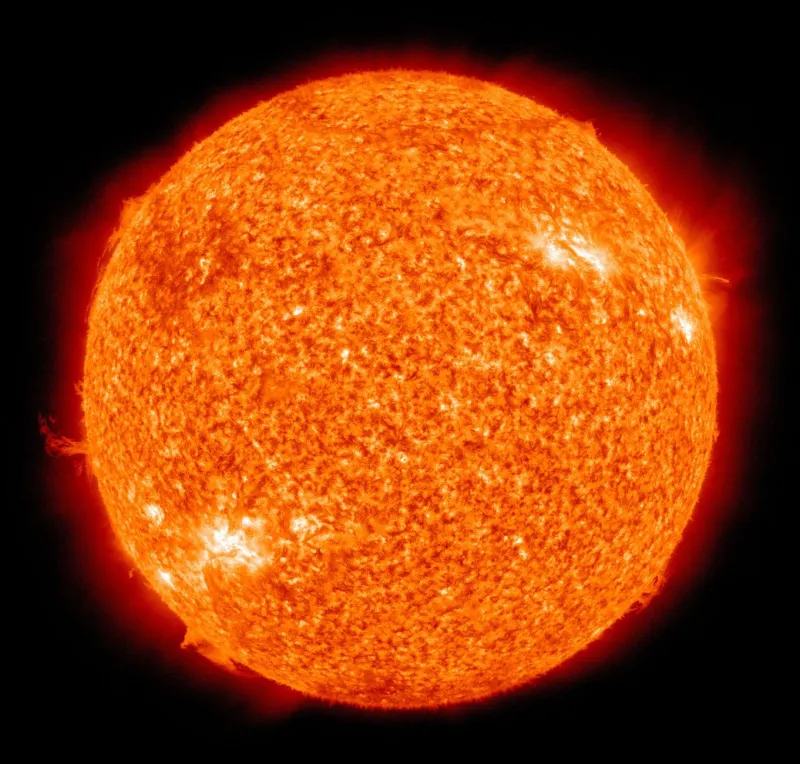
Your phone buzzes with a space weather alert. A solar flare just went off. You glance at the notification, maybe share it with a friend who's into astronomy, and move on with your morning. What you probably don't picture is the invisible avalanche of subatomic bullets that just left the Sun's atmosphere and are currently threading their way through a 93-million-mile electromagnetic obstacle course — headed, more or less, straight for you.
This is the story of solar energetic particles, or SEPs. And it's a lot weirder, faster, and more complicated than most people realize.
The Starting Gun: What Actually Launches These Things
Not every solar eruption sends a particle barrage toward Earth. The Sun produces two main types of explosive events — solar flares and coronal mass ejections (CMEs) — and while both can generate SEPs, they do it through different mechanisms and with very different results.
Solar flares are intense bursts of electromagnetic radiation, basically the Sun throwing a lightning bolt of X-rays and gamma rays into space. But they also accelerate particles — mostly protons and electrons — through a process tied to magnetic reconnection. When opposing magnetic field lines snap and reconnect near the solar surface, the energy released is staggering. Some of that energy goes into light. Some of it goes directly into kicking particles to near-relativistic speeds.
Coronal mass ejections, on the other hand, are slower and bulkier. They launch billions of tons of magnetized plasma into space like a slow-motion explosion. But as that plasma bubble pushes outward, it drives a shock wave ahead of it. That shock wave is an incredibly efficient particle accelerator. Protons caught in front of a fast-moving CME shock can be boosted to energies that would make a particle physicist raise an eyebrow.
The most dangerous SEP events — the ones that threaten satellites, disrupt GPS signals, and force airlines to reroute polar flights — often come from a combination of both: a flare that fires off the first wave of particles, followed by a CME shock that keeps accelerating more as it barrels outward.
The Electromagnetic Maze They Have to Navigate
Here's where things get genuinely strange. The space between the Sun and Earth isn't empty. It's filled with the solar wind — a constant outflow of charged particles from the Sun — and threaded through with magnetic field lines that spiral outward like water from a spinning sprinkler. This structure is called the Parker spiral, named after physicist Eugene Parker who predicted it back in 1958.
SEPs don't just fly in a straight line from the Sun to Earth. They follow those magnetic field lines, spiraling along them like beads on a curved wire. Whether a solar eruption's particles actually reach Earth depends enormously on where the eruption happened on the Sun's surface relative to the magnetic field line that connects to our planet.
If a flare goes off on the Sun's western limb — roughly the right side as we see it from Earth — it's magnetically well-connected to us because of the way the Parker spiral curves. A flare from the eastern limb might send a particle storm that misses Earth entirely, even though it looks just as dramatic in satellite imagery. Solar physicists call this the "magnetic connection" problem, and it's one of the main reasons why predicting which eruptions will actually hit us remains so frustratingly difficult.
Fast, Faster, Fastest: The Timeline That Should Alarm You
Light from the Sun takes about eight minutes to reach Earth. SEPs from a major event can arrive in as little as 30 minutes for the fastest protons, which can travel at 50 to 80 percent the speed of light. In extreme cases — rare, high-energy events called ground-level enhancements — particles energetic enough to penetrate Earth's atmosphere and register on ground-based neutron monitors have shown up in under 15 minutes.
That's roughly the time it takes to watch an episode of a sitcom. From eruption to particle storm at Earth.
For context, a CME — the slower plasma cloud — takes anywhere from 15 hours to several days to arrive. The SEPs are the advance scouts. They're the warning shot. Which is actually useful, because scientists can detect the first arriving particles and use them to estimate how bad the CME impact might be when it eventually shows up.
But that warning window can be terrifyingly short. In operational terms, 30 minutes isn't a lot of time to protect sensitive satellites or warn astronauts on the International Space Station to shelter in a more shielded section of the vehicle.
Why Some Storms Hit Hard and Others Fizzle Out
Even when the magnetic connection is good and a major eruption fires directly toward Earth, not every SEP event delivers the same punch. The intensity depends on a cascade of factors that scientists are still working to fully untangle.
The energy of the CME shock matters enormously — faster shocks accelerate particles more efficiently. The composition of the solar corona at the eruption site plays a role. Even the background solar wind conditions between the Sun and Earth affect how particles propagate; a turbulent solar wind can scatter SEPs and reduce their intensity at Earth, while a smoother wind can act almost like a highway that lets them arrive in concentrated bursts.
There's also something called the "seed population" — a pre-existing pool of already-slightly-energized particles in the corona that a shock can then boost to dangerous energies. Without a good seed population, even a fast CME might produce a relatively weak SEP event. With one, the same eruption could produce a radiation storm that puts satellites at risk.
What This Means for the Tech We Depend On
SEP events aren't just an academic curiosity. A strong solar particle storm can degrade or permanently damage satellite electronics, corrupt GPS signals, and expose airline passengers on polar routes to radiation doses equivalent to several chest X-rays in a single flight. During the famous Halloween solar storms of 2003, some satellites lost years off their operational lifespans in the span of a few days.
For astronauts beyond low Earth orbit — the kind of missions NASA and private companies are actively planning for the Moon and eventually Mars — SEPs represent one of the most serious health hazards of the journey. Earth's magnetic field provides a decent shield at low orbit, but step outside that bubble and you're exposed to whatever the Sun decides to throw.
The good news is that space weather forecasting has improved significantly. Satellites like NASA's STEREO probes and ESA's Solar Orbiter give scientists views of the Sun from multiple angles, helping to identify which eruptions are magnetically connected to Earth. Real-time particle monitors at the L1 Lagrange point — about a million miles sunward of Earth — can detect the first arriving particles and trigger automated alerts.
The bad news is that the physics is still messy enough that false alarms are common and genuine events sometimes catch forecasters off guard. The Sun, as always, doesn't make it easy.
The 93-Million-Mile Commute, Decoded
Next time you see a space weather alert on your phone, take a second to appreciate what's actually happening. Somewhere on the Sun's surface, magnetic field lines snapped and reconnected with enough violence to accelerate protons to a meaningful fraction of light speed. Those protons are now spiraling along invisible magnetic highways through the inner solar system, dodging or threading through planetary magnetic fields, and closing in on a pale blue dot that mostly has no idea they're coming.
The fact that we can detect them, track them, and sometimes even predict them is one of the quieter triumphs of modern astrophysics. The fact that we still can't fully predict which eruptions will send them our way is a reminder that the Sun — 93 million miles away — is still very much calling the shots.