Pencil, Paper, and the Sun: Meet the Amateur Astronomers Still Drawing Sunspots by Hand
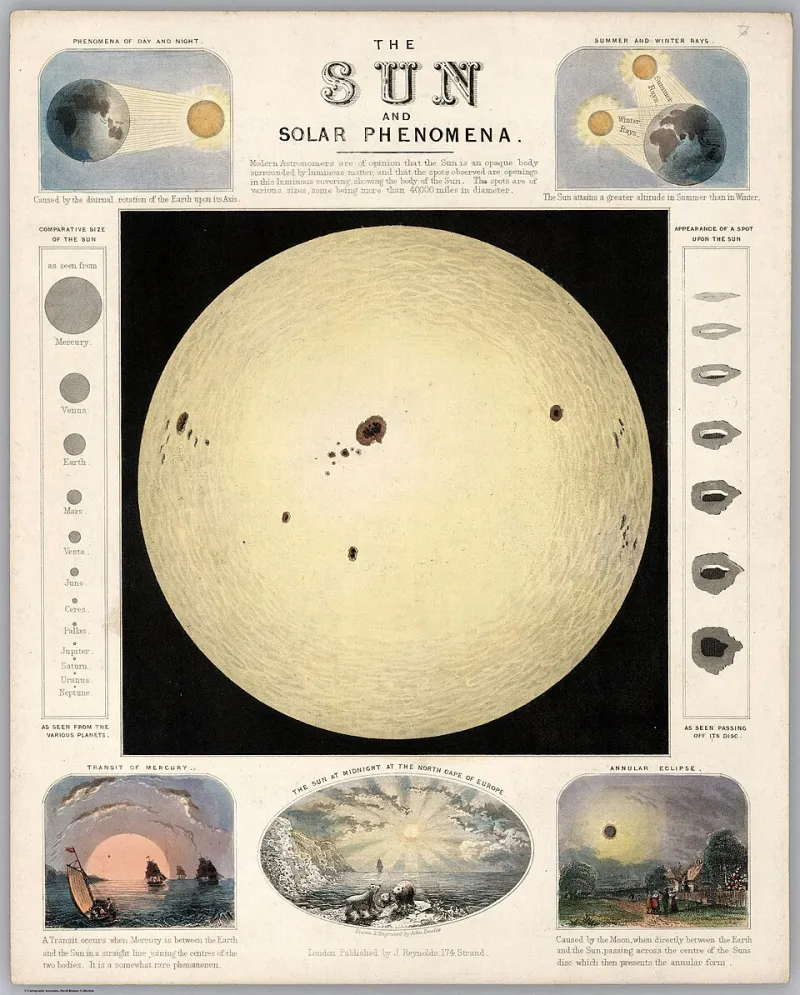
Photo: Reynolds, James Emslie, John, Public domain, via Wikimedia Commons
On a clear morning in the Arizona desert, a retired engineer sets up a small refractor telescope on his patio, tapes a white card to an eyepiece projection screen, and does something that would strike most people as charmingly obsolete: he draws the Sun. By hand. In pencil. Then he mails the sketch to Belgium.
He's not alone. Scattered across the United States — and around the world — a few hundred amateur observers maintain the practice of visual sunspot counting and hand-plotting, feeding their numbers into databases like the American Association of Variable Star Observers (AAVSO) Sunspot program and the long-running SILSO network in Brussels. In an era when satellites capture megapixel images of the Sun every few seconds, the pencil-and-paper method sounds like a living museum piece.
It's actually load-bearing infrastructure.
Why Machines Need the Pencil Pushers
Here's the problem that keeps solar data archivists up at night: the sunspot number — the single longest continuous scientific record of any kind, stretching back to Galileo — was built by humans eyeballing the Sun through telescopes. Every observer sees slightly differently. Every instrument has quirks. When methods changed, the record shifted, and the corrections are educated guesses layered on educated guesses.
Modern automated systems are consistent, but they're differently inconsistent — they measure things differently than a human eye does, so you can't just splice their data onto the historical record without a bridge. That bridge is the visual observer. Because a small number of people still observe the Sun the same way observers did in 1950, 1900, and 1850, their counts anchor the old data to the new. Retire the analog observers, and the anchor line goes slack.
"The satellites are fantastic," as one longtime AAVSO observer puts it, "but they've only been flying for a few decades. The paper record is four centuries long. Somebody has to speak both languages."
A Hobby That's Quietly Dying Out
The uncomfortable truth: the median hand-drawing solar observer is getting older, and the pipeline of replacements is thinning. Learning to observe consistently takes years — your eye has to be calibrated against the program's standards, your seeing conditions characterized, your counting habits stabilized. It's the opposite of instant gratification, in a hobby culture that increasingly runs on smartphone astrophotography and one-click stacking.
The economics don't help. Solar telescopes with proper filtration, projection gear, and the discipline to observe on every clear morning add up to a serious commitment of money and, more importantly, routine. There's no viral video in it. There's no app.
What Gets Lost If Nobody Picks Up the Pencil
Solar cycle prediction, climate model boundary conditions, long-term space weather risk assessment for the US power grid — all of it leans on that continuous sunspot record. Break the calibration chain, and every future researcher inherits a fuzzier picture of how our star actually behaves over centuries.
A few programs are fighting back. AAVSO actively recruits and trains new solar section members, and some observers have started digitizing decades of their own paper logs before the originals degrade. But the gap between the number of people needed and the number of people doing it is real.
So if you know someone with a telescope and too much patience, mention it. The Sun's longest-running diary is still being written — in pencil, on index cards, by a handful of people who answer to nobody but the data. Somebody should probably thank them. Better yet, somebody should join them.