No Clouds, No Shelter: What Space Weather Looks Like From the Lunar Surface
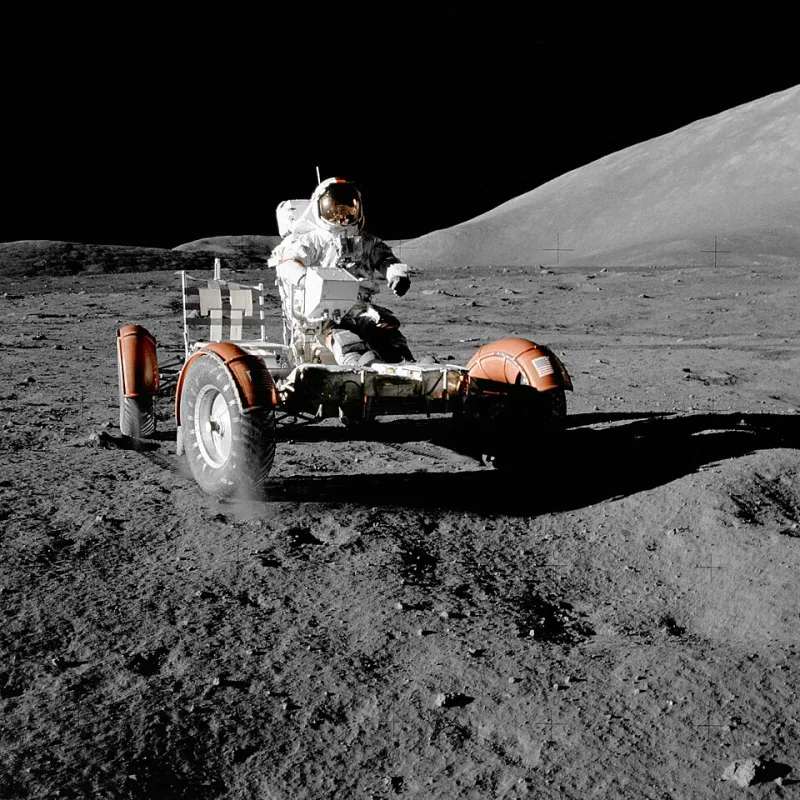
Photo: NASA / Harrison H. Schmitt, Public domain, via Wikimedia Commons
Ask anyone what the weather is like on the Moon and you'll get a joke about the forecast. No rain, no wind, no clouds, done. And that's exactly the assumption that makes lunar space weather so treacherous — because the Moon does have weather, it's just solar instead of atmospheric, and there is nothing whatsoever standing between the surface and the sky.
The Missing Shield Is the Whole Story
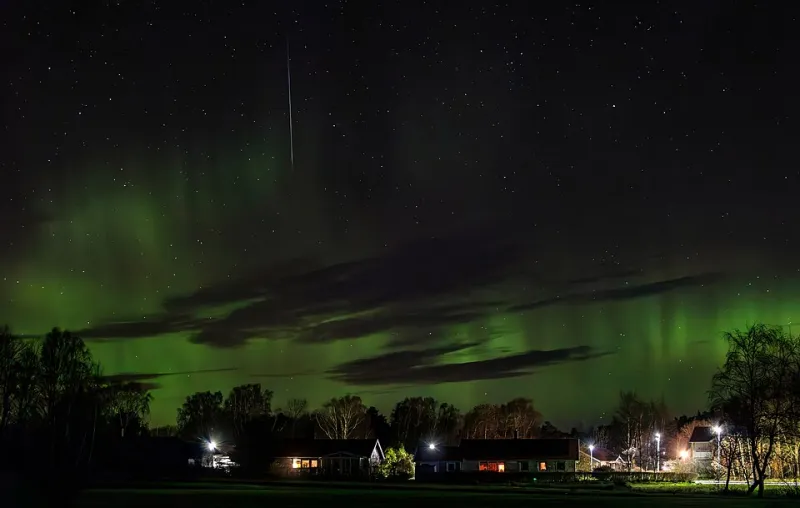
Earth is a fairly cushy place to ride out a solar storm. A thick atmosphere absorbs most of the energetic particles that reach us, and the magnetosphere deflects a good chunk of the rest, funneling them toward the poles where they put on auroras instead of frying electronics.
Strip both away and the geometry changes fast. The lunar surface receives the solar wind directly and continuously. When the Sun throws a coronal mass ejection at us, the Moon gets hit by the same plasma cloud Earth does, minus the magnetic cushion. And solar energetic particles — the fast, high-energy protons accelerated at flare sites and shock fronts — arrive at the surface essentially unimpeded, where they can penetrate suits, equipment racks, and skin.
There are patches of crustal magnetism scattered around the Moon, leftover from ancient dynamo days, that create tiny magnetic bubbles. They're scientifically fascinating and completely inadequate as a planetary defense system. They cover a sliver of the surface.
Two Ways to Get Irradiated, Not One
It helps to split the hazard. There's the slow, cumulative dose from galactic cosmic rays — a steady drizzle of high-energy particles from outside the solar system, modulated by the solar cycle, which astronauts on a long lunar stay would need to budget for like a financial planner watching a retirement account.
Then there's the acute event: a solar particle event, or SPE. These are the ones that keep mission planners up at night. A big flare or a fast CME-driven shock can accelerate protons to hundreds of mega-electron volts, and the leading edge of that radiation can reach the Moon in tens of minutes. Some events have delivered dose rates that would be a serious health concern within hours for an unshielded crew.
That timeline is the crux of the whole problem.
The Forecast Is Always Late
Near Earth, space weather forecasting has a workable trick: satellites sit at the L1 Lagrange point, about 1.5 million kilometers sunward, sampling the solar wind before it arrives. That buys roughly 15 to 60 minutes of warning for a CME's arrival — enough to safe a spacecraft, not enough to be comfortable.
For the Moon, that trick mostly evaporates. L1 is only 1.5 million kilometers from Earth, and the Moon is a mere 384,000 kilometers past that. A monitor at L1 gives lunar crews the same short-lead heads-up it gives Earth, sometimes less depending on geometry. And the particles that matter most are often accelerated close to the Sun and don't announce themselves with a clean, slow-moving shock front you can track.
Worse, the fast stuff and the light arrive nearly together on human timescales. Visible light takes about eight minutes to cross the gap. Energetic protons from a well-connected event might take twenty minutes to an hour. You cannot outrun a solar particle event by watching it happen.
And Then There's the Blind Spot
Half the time, the Moon's far side faces Earth. That's a radio-quiet paradise for astronomy and a communications desert for safety. Ground stations can't talk to a crew on the far side directly, so you need relay satellites or an orbiting asset to pass along a warning. If the relay isn't there, the warning isn't there.
On top of that, our solar monitoring is unevenly distributed. We see the Sun well from Earth's neighborhood and increasingly from other vantage points, but spacecraft coverage is finite. An active region can rotate into view, or erupt on the far side, and our first clue arrives as a particle surge rather than a picture.
The Architecture Becomes the Forecast
Given all that, the practical answer isn't better prediction. It's better engineering and doctrine.
Habitats designed with regolith shielding — piling lunar dirt over a module or berming it around a storm shelter — can knock down dose substantially. Water walls, dense storage lockers, and interior safe rooms do the same job. The operational rules look less like a weather app and more like a fire drill: dosimeters everywhere, defined dose-rate thresholds, and a crew trained to move to shelter on a signal rather than a discussion.
Surface operations add another twist. A spacesuit is a thin shell of fabric and polymer compared to a meter of packed regolith. Extended extravehicular activity during a particle event is simply not survivable in the way a habitat stay is, so the decision window is short and unforgiving. Rover routes, sample caching, and construction schedules all inherit a hard constraint that has nothing to do with daylight.
What Would Actually Help
More eyes on the Sun, from more angles. Coronagraphs and heliospheric imagers positioned away from the Earth-Sun line — the kind of coverage that missions to the L5 point or dedicated solar sentinel constellations would provide — would let forecasters watch active regions before they rotate into view and track eruptions from multiple perspectives.
Solar radio observations matter too, because radio bursts can flag particle acceleration in near real time, minutes before the particle front itself shows up in situ.
And locally, a radiation monitor on the lunar surface is not a luxury. It's the difference between knowing and guessing. Every habitat should be able to answer a simple question at any moment: how hot is it outside right now?
The Quiet Sky Is Not an Empty One
There's a temptation to treat lunar weather as a solved background condition. No air, no storms, nothing to plan around. The physics says otherwise. The Moon sits in a river of plasma and radiation that varies on timescales from minutes to decades, and any crew living there will be living inside that river.
The forecast for the lunar surface is a permanent, unverifiable "partly sunny, with a chance of protons." The real work is making sure that chance is survivable.