Umbra, Plage, Filament, Prominence: A Field Guide to Solar Jargon That Gets Misused
Photo: Fernando de Gorocica, CC BY-SA 3.0, via Wikimedia Commons
Every hobby has its password. Birders have "speculum" and "primary projection." Rock hounds have "cleavage" and "habit." Solar observers have a stack of terms that sound like they were generated by a random syllable machine — and that get traded around incorrectly in forum posts, image captions, and occasionally in news coverage of a storm that actually matters.
This one's for the amateurs who file observations to organizations like the Association of Lunar and Planetary Observers, who upload sketches to citizen science projects, or who just want to describe what they saw without accidentally announcing a catastrophe. Here's the glossary, roughly in the order you'll encounter things.
Umbra and Penumbra: One Spot, Two Parts
A sunspot is not a single blob. Look closely at a decent white-light image and you'll see a dark core wrapped in a lighter, ragged fringe.
The umbra is the inner darkness — the deepest part of the magnetic concentration, where convection is choked off and the plasma sits a thousand or more kelvin cooler than its surroundings. That temperature gap is why it reads as dark: contrast, not a hole.
The penumbra is the surrounding ring, made of slender radial filaments of alternating bright and dark. It's where the magnetic field is transitioning from near-vertical to nearly horizontal. Sunspots with a big, clean umbra behave differently from small, fragmented ones, which is why observers often note the u/penumbral ratio rather than just ticking a box.
Plage: The Bright Twin Almost Nobody Photographs
Say you're observing in hydrogen-alpha and you see a glowing patch near a sunspot group. That's a plage — a bright region in the chromosphere, typically sitting above an active region, hotter and denser than the surrounding chromospheric plasma.
Plages are the visible fingerprint of where the magnetic field is strong and vertical-ish, poking through the chromosphere. They don't generate their own press releases, but they correlate with activity and they show up wonderfully in calcium K imaging, which is a favorite amateur pursuit.
If you're shooting white light and see patches that get brighter toward the limb, you're probably looking at faculae, not plages. Different layer, different physics, different observing technique. The terms get swapped constantly and it drives the people who write the reports slightly up the wall.
Filament and Prominence: The Same Object, Different Background
Here's the cleanest rule in solar observing: it depends on where you're standing.
A filament is a cool, dense thread of plasma suspended in the hot corona, held up by twisted magnetic fields. Seen against the bright disk, it appears dark — an absorbing snarl crossing the chromosphere.
That same structure, viewed at the limb, projects against black space. Now it glows. Now it's a prominence.
Same object. Same physics. Two names, determined entirely by the geometry of your line of sight. Once you internalize that, a whole category of confusing captions collapses into clarity.
Flare, CME, and SEP: The Chain That Gets Flattened
News coverage loves to use these three as if they're the same event, and this is where imprecision stops being a hobbyist quibble and starts being a public-information problem.
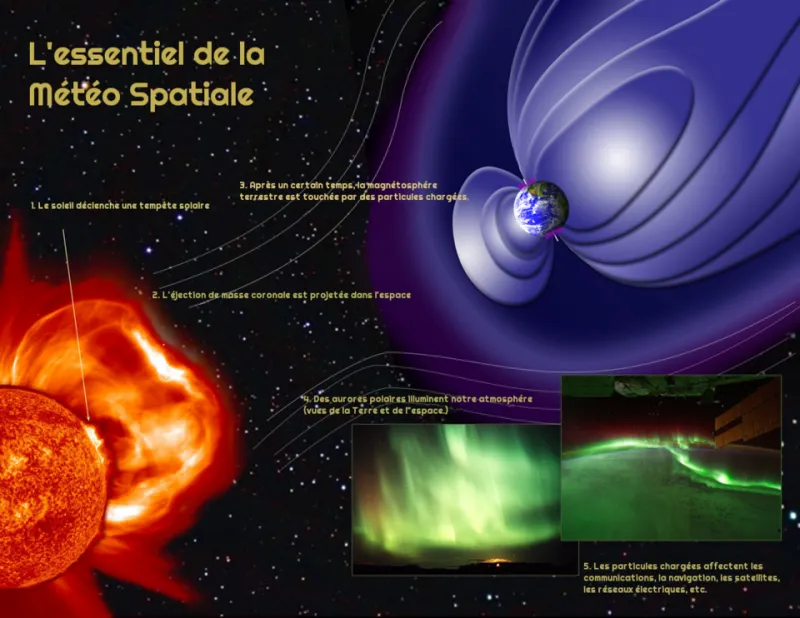
A solar flare is a sudden brightening — radiation across the spectrum, released when magnetic field lines reorganize. It's light. It arrives in about eight minutes and can disrupt radio communications on the sunlit side of Earth.
A coronal mass ejection is a billion-tonne chunk of plasma and magnetic field flung outward. It takes anywhere from fifteen hours to a couple of days to reach Earth, and it's the thing that compresses the magnetosphere and causes geomagnetic storms and auroras.
Solar energetic particles are the fast, high-energy protons and electrons accelerated near the flare site and at the CME's shock front. They arrive in between — minutes to hours — and they're the primary radiation hazard for spacecraft and crews.
Three things. Three timescales. Three separate hazards. A flare pointing away from Earth can still produce a spectacular limb event and zero impact. A "quiet" region can launch a CME with no flare at all. Conflating them is how a routine M-class flare becomes a headline about the grid collapsing.
Coronal Holes: The Dark Voids That Drive Weather
In extreme ultraviolet images and certain X-ray channels, you'll see large, irregular dark patches on the disk. Those aren't holes in the Sun any more than sunspots are. They're regions where the magnetic field opens outward instead of looping back, letting fast solar wind escape. The plasma there is cooler and less dense, so it looks dark.
Coronal holes are workhorses of space weather. They send high-speed streams that buffet Earth's magnetic field and can cause recurrent storms tied to the Sun's 27-day rotation. They rarely trend on social media. They should occasionally.
Granulation and Supergranulation: Two Very Different Cells
Look at a high-resolution white-light image — something from the Inouye Solar Telescope, say — and the surface looks tiled with cells a few hundred to a couple thousand kilometers across. That's granulation: convection cells, hot plasma rising in the middle and cooler plasma sinking at the edges, with lifetimes measured in minutes.
Supergranulation is the larger pattern underneath, roughly 30,000 kilometers across, with lifetimes of a day or two. It's tied to the magnetic network and organized flows rather than to the visible boiling.
Same word family. Wildly different scale. If someone describes granulation as "the Sun's magnetic cells," they've mixed two concepts.
Why This Isn't Just Pedantry
Precious little of this matters if you're just enjoying a pretty picture. But the vocabulary leaks outward. Storm coverage quotes observers. Observers write captions. Captions become posts, and posts become the thing your neighbor believes about whether the power will stay on.
Getting the words right is a small act of citizen science. A careful observer who writes "H-alpha filament on disk, limb passage expected tomorrow" is contributing something precise and useful. One who writes "huge prominence exploding on the Sun right now" is contributing noise — and a mild headache for whoever has to correct it.
The Sun's vocabulary is finite and learnable. Learn it once and every observation you make, sketch you file, and post you write gets a little sharper.