The Sun Has Two Blind Spots, and They May Control the Next Solar Cycle
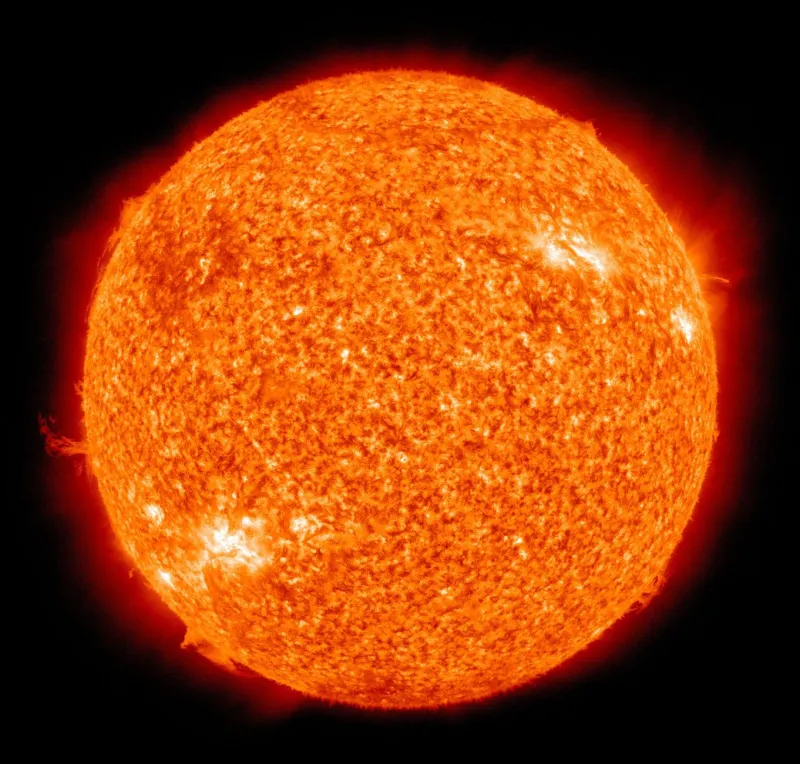
Every picture of the Sun you have ever seen has a hole in it. Not a literal one — more like a blind spot with excellent public relations. Sunspots, flares, filaments, the boiling granulation of the photosphere: all of it has been catalogued in absurd detail for decades, because nearly all of it lives in a band running roughly 30 degrees north to 30 degrees south of the solar equator. That band is where spacecraft point. It is where Earth points. It is, conveniently, where the drama happens.
Except the part that might matter most.
Two caps nobody is really watching
The Sun's polar regions — the last few dozen degrees at either end of its rotation axis — are the thinnest-data territory in all of heliophysics. And the reason is geometry, not laziness. From Earth, the poles are always seen at a glancing angle, so the magnetic measurements that solar physicists rely on get smeared across a shallow sliver of limb. Reading a magnetic field that way is like trying to identify a face by its shadow on a wall.
So we built spacecraft. Almost all of them stayed in the ecliptic — the flat plane where the planets live — because that is where Earth is and where the fuel budget wants you to be. The Sun's crown has stayed blurry anyway.
What Ulysses saw when it left the flatlands
The one mission that genuinely went up and over was Ulysses, a joint NASA/ESA probe that used a Jupiter gravity assist in 1992 to swing into a polar orbit no spacecraft had attempted before. Its passes in the mid-1990s and again around the turn of the century produced one of the cleanest results in solar physics: the fast solar wind, streaming out at roughly 750 kilometers per second, comes from polar coronal holes. Over the poles, the slow, gusty wind that batters Earth's magnetosphere barely showed up at all.
Ulysses also complicated the tidy picture. The polar magnetic field turned out to be weaker and more finely structured than models predicted, and the heliospheric field at high latitude looked less like a smooth dipole and more like a braid. Ulysses was switched off in 2009. Nobody has flown a dedicated polar mission since.
The polar field is the dynamo's input port
Here is why the blank spot matters beyond curiosity. The Sun's magnetic field is generated and recycled by a dynamo deep inside it, and the polar fields are effectively the flywheel. Magnetic flux from decaying active regions drifts poleward on a slow meridional conveyor, and that accumulated polar flux seeds the next cycle.
Which means the poles are a forecasting instrument. The polar field strength near solar minimum has been used for decades as a predictor of the following cycle's size, with mixed but real skill. The problem is resolution: we have been reading that instrument through frosted glass, reliant on a small number of ground-based observatories and a lot of interpolation. Predictions for the cycle now finishing varied wildly, and not only because the Sun is difficult.
Cycle 26 is already on the table. Researchers are arguing about whether it arrives early, late, or weak, and a good chunk of that argument rests on polar measurements we do not have.
Solar Orbiter is climbing, slowly
Solar Orbiter, the ESA/NASA mission launched in 2020, is the closest thing to a successor. Repeated Venus flybys are ratcheting its orbit out of the ecliptic, with inclinations climbing toward roughly 33 degrees by the end of the decade. That is not a true polar view — nowhere near Ulysses' 80 degrees — but it is the first sustained look at the Sun's mid-latitudes with modern instruments, and it is already changing how scientists think about the boundary between the fast and slow wind.
Meanwhile Parker Solar Probe dives deep but stays shallow, with an inclination of only a few degrees. It samples the wind where it is born, not where it is crowned.
The physics that lives at 90 degrees
High-latitude observations matter for reasons that go beyond cycle prediction. Polar coronal holes are the sources of the high-speed streams that produce recurring geomagnetic disturbances during the declining phase of a cycle — the steady, drumbeat kind of space weather rather than the explosive kind. Their shape, their boundaries, and how they evolve as the polar fields reverse polarity during solar maximum are all under-measured. Some of the disagreement about how the solar wind is accelerated comes down to a lack of data from the one place the acceleration is cleanest to observe.
There is also the small-scale flux problem: the polar caps are packed with tiny magnetic elements that may contribute meaningfully to the Sun's total open flux. Without polar magnetograms at high resolution, that contribution is essentially estimated rather than measured.
What a polar vantage point would buy
A dedicated polar sentinel — a spacecraft in a high-inclination orbit, ideally paired with a second one at a different longitude — would do three things at once. It would give continuous, unobstructed magnetograms of both poles. It would let modelers watch the polar field reverse polarity in real time instead of reconstructing it afterward. And it would finally let us test whether polar precursors can do better than statistical coin-flipping.
Concepts have been studied on both sides of the Atlantic, and repeated decadal reviews of heliophysics have flagged the polar regions as a priority observational gap. The obstacle is not physics. It is orbital mechanics and a budget line: getting to a high inclination costs a Jupiter-class gravity assist, which means a long cruise and a patient program office.
In the meantime, the most photographed object in the universe keeps two of its most consequential regions pointed away from the camera. Ulysses showed what is up there. It has been seventeen years of silence since.
Infopunks of Sol covers the Sun, the heliosphere, and the messy business of trying to understand a star we cannot visit. If you liked this, our space weather coverage goes deeper on the storms that actually reach Earth.